Attorney for longtime marijuana opponent requests Nebraska Supreme Court note Grand Island criminal case
By:Zach Wendling
Nebraska Examiner
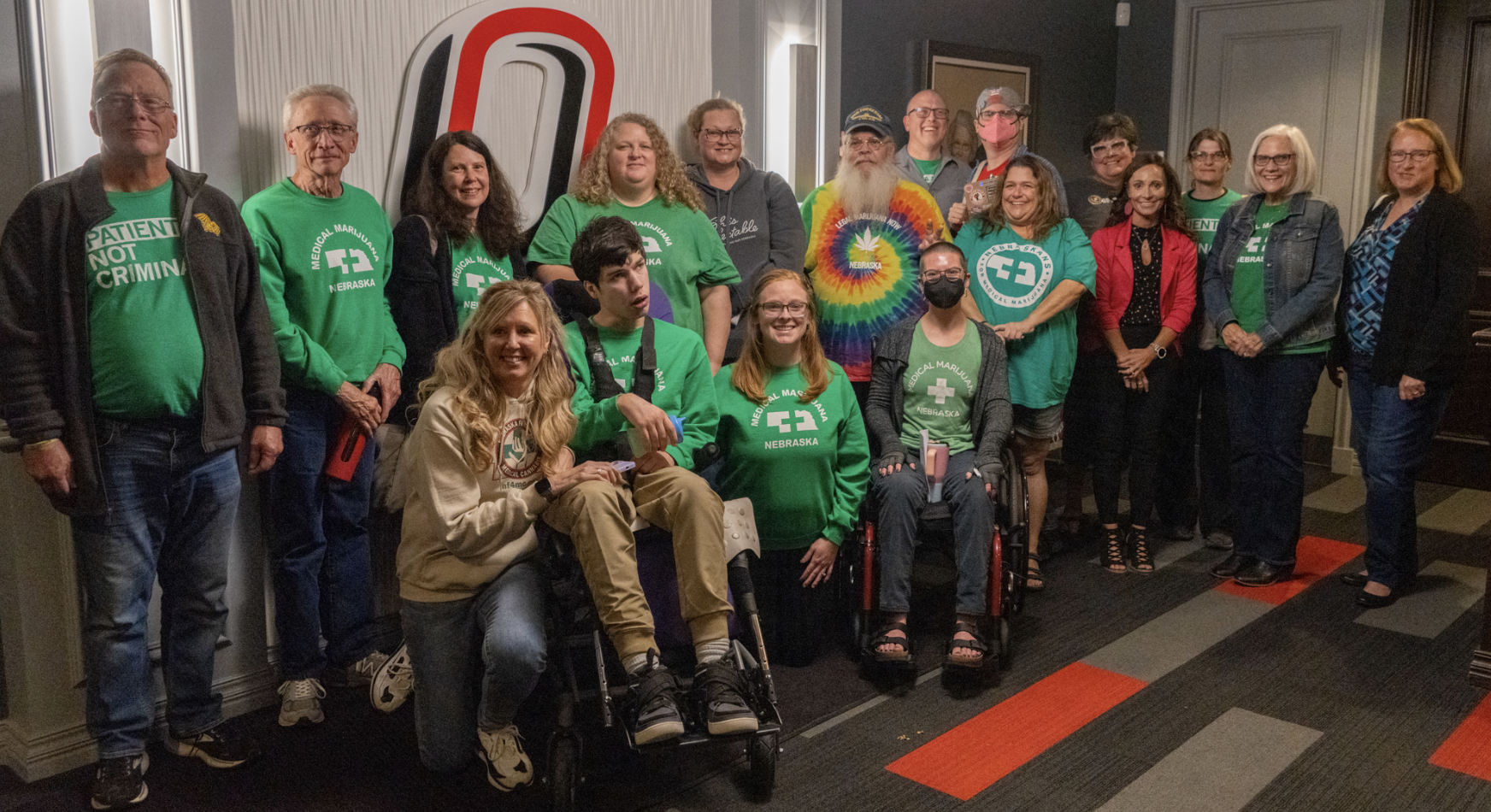
LINCOLN — Nebraskans for Medical Marijuana stood behind its 2024 campaign to legalize and regulate medical cannabis, a day after a Hall County jury convicted one of the campaign’s volunteer notaries on 24 misdemeanor criminal charges.
A six-person jury convicted Jacy C. Todd of York, 55, on Wednesday of 23 counts of “official misconduct” as a result of 23 days of improper notarizations involving Michael K. Egbert of Grand Island, 67, a petition circulator. Todd also was found guilty of lying in an October 2024 deposition as part of a separate trial over whether the campaign had enough valid petition signatures.
Lancaster County District Judge Susan Strong, a few weeks after the 2024 election, issued a 57-page order siding with the campaign in a separate case, saying the measures had been properly placed on the ballot.
Crista Eggers, executive director of Nebraskans for Medical Marijuana, told reporters on Thursday that Strong’s ruling came after a four-day trial with many witnesses and experts.
“We stand, I stand, my organization stands and I believe the voters stand behind that these were absolutely legally on the ballot,” Eggers said. “Voters went forward and voted, and it is time to start moving forward and doing something with this issue, rather than trying to stand in the way at every single opportunity.”
In November 2024, Nebraskans overwhelmingly voted to legalize and regulate medical cannabis. The laws took effect Dec. 12, 2024.
86,499 valid signatures needed
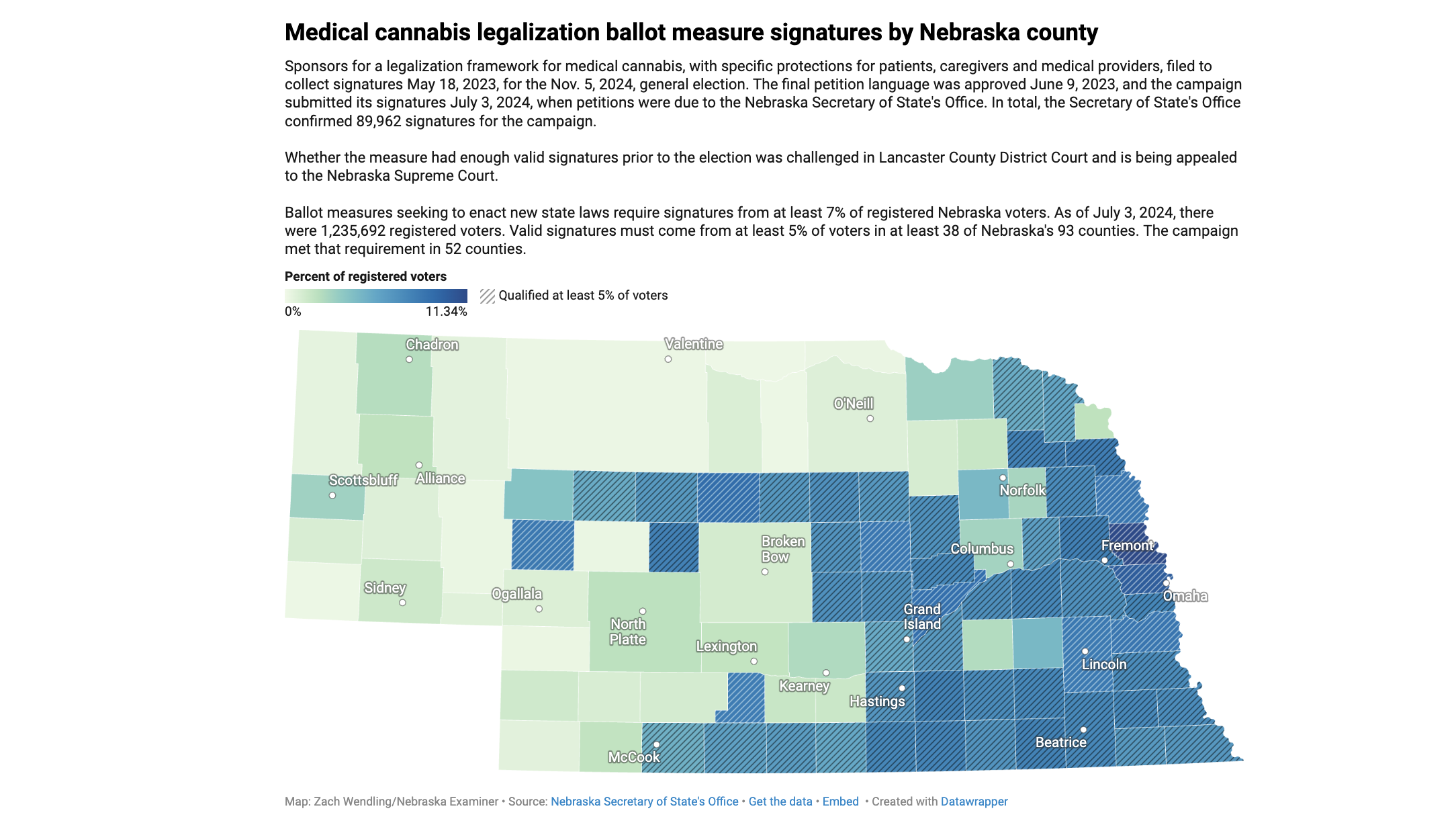
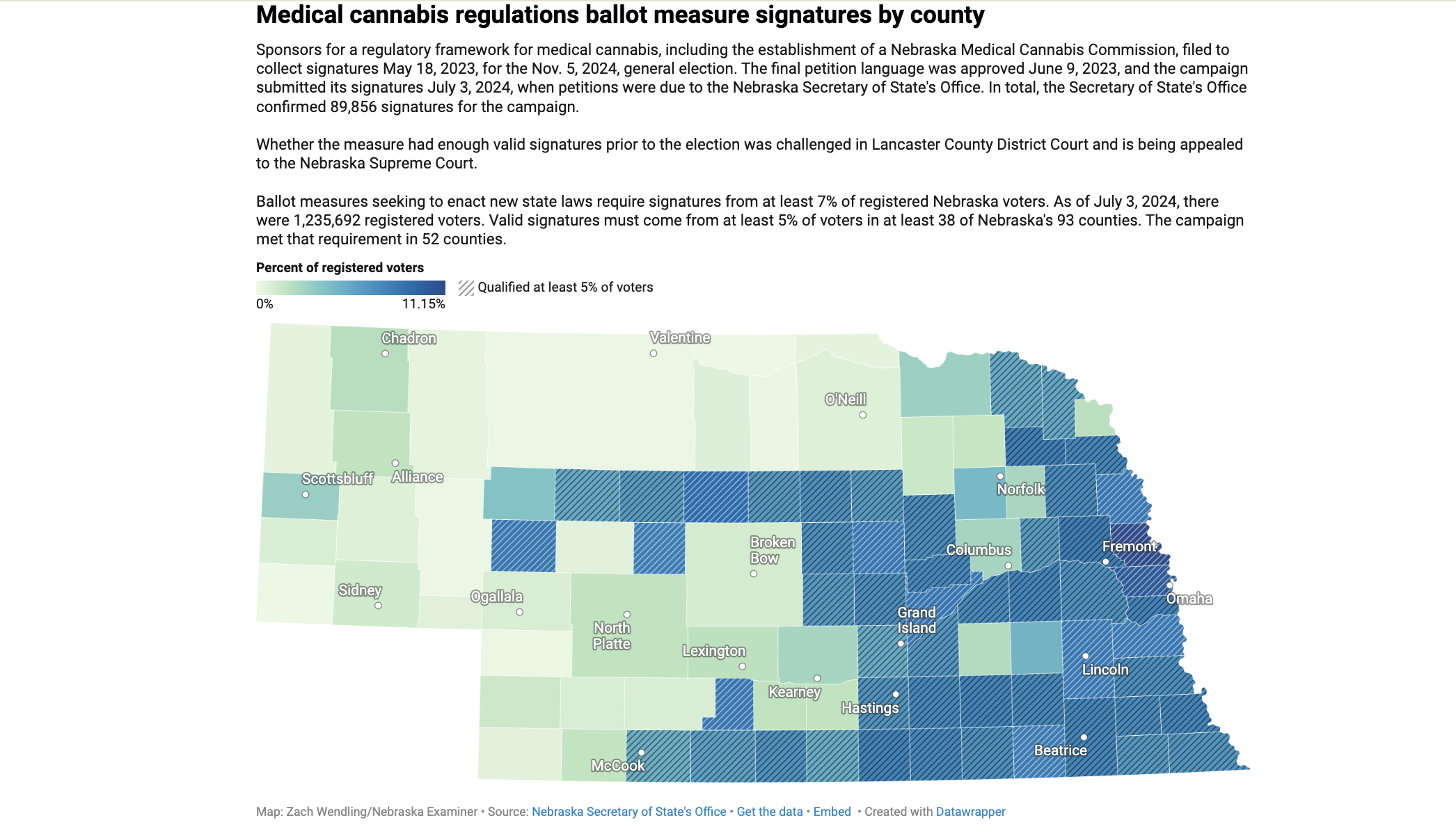
The campaign needed at least 86,499 valid signatures on each of its separate measures. Nebraska Secretary of State Bob Evnen certified 89,962 valid signatures for the one legalizing medical cannabis, and 89,856 for the one regulating it. The case did not address county-specific signature requirements.
Strong upheld the presumptive validity of the more than 4,000 signatures Todd notarized across the two measures but said the more than 1,000 validated signatures Egbert had collected — all but a dozen or so notarized by Todd — had lost the presumption of validity.
Egbert admitted to forging signatures using a phone book and pleaded guilty in November 2024 to a Class I misdemeanor of an “attempt” to falsify his circulator’s oath on the petitions.
Former State Sen. John Kuehn of Heartwell, a longtime marijuana opponent who brought the Lancaster County civil case, has appealed Strong’s decision to the Nebraska Supreme Court. Evnen and Nebraska Attorney General Mike Hilgers, who advanced similar arguments as Kuehn against the campaign, also appealed.
The case went before the Supreme Court on Dec. 3. A decision has not yet been issued.
Hilgers, whose office coordinated with Hall County Attorney Marty Klein on Todd’s criminal case, said Todd’s case offered evidence of a “systematic scheme in which the law was routinely violated.”
“As we have said all along, the medical marijuana petition campaign was built on fraud and malfeasance and ultimately should never have been on the ballot in the first place,” Hilgers said Wednesday.
The campaign has denied allegations of widespread wrongdoing but acknowledged that some mistakes occurred. Strong addressed some of those mistakes in her ruling.
Supreme Court appeal
Shortly after Todd’s conviction Wednesday, Kuehn’s attorneys filed a motion with the Supreme Court requesting that the justices take notice of Todd’s conviction and other trial materials.
In the filing, attorneys said the conviction is in “direct contrast” to Strong’s ruling regarding Todd.
Todd, in the Lancaster County case and again this week, denied wrongdoing. Egbert also testified in both trials, where he said he has a neurological condition that affects his memory. Egbert said he never signed his petitions in front of Todd, which is an improper notarization.
At the time of the civil trial, Strong said “Egbert’s credibility problems are more serious” than Todd and that Kuehn and Evnen had not shown “by a preponderance of evidence” that any other petitions that Todd notarized should lose a “presumption of validity.”
The “presumption of validity” means signatures verified by local county officials and assumed to have been legitimately collected because of a notarized circulator’s affidavit.
If a signature loses its presumption of validity, the campaign could have a chance to rehabilitate the signature in a second phase of trial. Invalidating either petition would require nearly 3,500 signatures to lose the presumption of validity.
Even if all of Todd’s notarized signatures lost the presumption of validity, the campaign would still have met its threshold for the ballot.
This week, a central Nebraska jury sided with the version of events described by Egbert and state and local prosecutors. Todd’s attorney said Todd would appeal after his 9 a.m. April 22 sentencing hearing.
Eggers did not say whether she was concerned Todd’s conviction might impact the appeal but said the campaign is looking forward to the Supreme Court’s decision.
“I believe that the Supreme Court is a body that is going to rule fairly on this issue,” Eggers said. “They are going to take into consideration the things that they need to, and the appeal that was presented to them, but I believe they’re still well within their time of getting a decision.”